Four stories here to focus on up front and then on to others.
The first of course is the Sinclair story. [Note that this is their own text of the broadcast ban, and that it is posted on their top webpage.] This is absolutely insane and unparalleled in American TV media.
By now you probably already know the story. Ted Koppel's Nightline program tonight is spending it's entire 30 minutes simply reading the names of our 500 (and then some) combat dead from Iraq as photos of them are displayed. Though both Koppel and ABC have both stated that this has no political intent and is merely to honor our fallen, Sinclair has barred their three ABC stations from airing the program.
I must point out here that this will be no ratings winner for ABC. Many viewers of Nightline will probably just move on after five or ten minutes, and if you'll recall, Koppel was almost cancelled a bit back, saved only by our outrage that ABC would even consider doing this.
A few moments on the Sinclair Broadcasting Group. They are highly partisan, their four top executives giving the maximum allowed to the Bush campaign while giving nothing at all to anyone that disagrees with Bush. While they only own eight ABC stations, they also own 20 FOX, 19 WB, 6 UPN, 3 CBS, 4 NBC affiliates and 2 independent stations and they claim to reach approximately 24% of all U.S. television households. While a mere 8 ABC stations are being shut off this time, there is no reason to expect Sinclair to do otherwise with their 54 other stations should those occasions arise. Pure and absolute censorship whenever it might seem to go against their own financial greed.
But we are not alone in our outrage of this dispicable censoring. From John McCain (R-AZ), unimpeachable in his concern for our troops:
Your decision to deny your viewers an opportunity to be reminded of war's terrible costs, in all their heartbreaking detail, is a gross disservice to the public, and to the men and women of the United States Armed Forces. It is, in short, sir, unpatriotic. I hope it meets with the public opprobrium it most certainly deserves.From Bernie Sanders (Ind-VT), a similar outrage:
Your company's shameful and cynical statements disrespect both the victims of terrorism and the brave Americans who have made the ultimate sacrifice in the Persian Gulf. It is an outrage to suggest that giving recognition to the fallen in Iraq is an attempt to sabotage their mission. These American heroes deserve to be heralded, not hidden in the closet. The Nightline show in question will allow all Americans to personalize the service and sacrifice of the pride of the nation.Your company's censorship sets a dangerous precedent that is contrary to the First Amendment and America's long tradition of access to information. This is an issue that some of my colleagues and I will be addressing with the FCC. Frankly, to censor information you disagree with has very little to do with freedom and what makes this country great. It sounds more like totalitarianism.
But on to Dr. Death's other recent press tampering event.
It seems that the doctor has recently conversed with Sheikh Hamad bin Jassim from Qatar. The doctor's problem? al-Jazeera is based in Qatar, and the Sheikh's problem is that Qatar really likes our foreign aid supplements to his country. Dr. Death's message to the Sheikh: Go home and take care of the al-Jazeera "problem".
Now, three stations is a flea bite for Doug, but the point here is that Doug was directly told that he was being tossed for his political views on Bush. Worse still however is that Doug hardly rages against Bush, as his program is much more of a variety show than it is political. Doug simply has too wide an audience.
A very sorry state of affairs indeed.
These days, Stern's broadcasts are divided between his usual schtick — interviews with strippers, off-color song parodies, jokes about celebrities — and rants against the president. Stern will never be mistaken for a policy wonk, but tune in to his show and you'll hear him cogently attacking administration positions on an impressive range of issues: stem-cell research, abortion rights, gay marriage, media consolidation, the handling of Iraq.Most people simply think of Howard as a "shock jock", but make no mistake; Howard's a quite successful businessman. He's survived more FCC fines than you and I will ever earn in a lifetime.Meanwhile, Stern's revamped website looks more like Mother Jones magazine than Maxim: It features articles about the administration's trade violations in Myanmar and includes a link to the contributions page of the John Kerry for President site. Indeed, Stern has become an ardent Kerry advocate. "I call on all fans of the show to vote against Bush," he said on a recent broadcast. "We're going to deliver the White House to John Kerry."
Michael Powell, on the other hand, is a token appointee, slid in on some perverted form of nepotism. No contest. Whatever you might think of Howard's listeners, he's delivering them to Kerry.
Mark Levine served as Legislative Counsel to a high-ranking Democratic Member of Congress on the House Judiciary Committee and the House Select Committee on Homeland Security. He has an economics degree magna cum laude from Harvard College and a law degree from Yale. He also was a Presidential Scholar and a Fulbright Scholar in Switzerland.If you listen in (the stream works quite well on dial-up), you'll find Mark has a quite good grasp of progressive legal issues, and though he does not focus exclusively on these, his programs are all well flavored by this. If you want to sample him when he is not on, his archives are available through his site and on the excellent White Rose Society. I especially recommend "Mark Levine Interviews George Dubya Bush". I'd also recommend "Beyond the Abortion Debate", which I forwarded to a rabid pro-lifer and got a thumbs up from her on it.
If you want something shorter, you might try the e-mail Mark sent a good while back (to only 20 people, by the way) that ended up starting his talk radio career: The "Gore Exception": A Layman's Guide to the United States Supreme Court Decision in Bush v. Gore. This e-mail has since been passed along to over 10,000 people since then, and is a definitive analysis of Bush v. Gore at four law schools.
And by the way, Mark's still fairly small, and so it's still fairly easy to get through to him during the show via both phone and e-mail. Check him out.
May Be Significant Liability in Close Race
It is all part of an increasingly pointed Democratic strategy of trying to define the president -- and erode his personal credibility -- by turning Mr. Cheney into a symbol of Republican excess. Though vice presidents rarely play decisive roles in presidential elections, Mr. Kerry and his allies believe this vice president could become a significant liability for Mr. Bush in a race that appears close.Finally! Attack the real President, Dick Cheney. What a thought!
Yes, I've heard of all the speculation about Cheney being replaced, but why not give him a shove. Think of the upside. If Bush does win by replacing Cheney, at least we'll be rid of Doctor Death.


 Chris Floyd:
Mehlman's minions believe exurbia offers rich pickings for the Bush cult -- and they're probably right. People who live in fake towns, with fake stores and fake horses, are likely to be happy with a fake president, who uses fake evidence and fake words about "freedom" and "peace" to launch all-too-real wars of conquest while turning the national treasury into a candy store for his cronies.Is it any wonder that the cozy exurbians prefer cults and fakery to such fearsome truths?The exurbanites' virtual reality is a perfect reflection of the dreamworld where half the nation now dwells, ...
* * *But fake horses are more tractable than powerful live beasts -- and self-serving lies are easier to handle than a volatile, complex reality. Anyway, is it really so surprising that so many Americans prefer a Potemkin world? Otherwise, they would have to accept the incontrovertible facts: that mass murder is being committed in their name; that their leader is a terrorist -- a fanatic who pursues political goals through wanton violence -- just like the enemy who attacked them; that they have been deceived, betrayed, exploited, suckered and bought off -- sometimes willingly -- for years, for decades, by elites whose crimes and follies are now blowing back in firestorms of rage and hatred.
[ As always, lots of good links.]

The New York Times writes the article, but by all means, do the video of his full presentation. It's fairly low quality and it streams (in four continuous segments), so it should present no problem even for dial-up.
Because of my own focus on Afghanistan (most recently in "The Perfect Alibi"), I would make note here of both of her last questions for Bush and Cheney:
For President Bush:Neither of these are what might be called "fishing expeditions". The paper trails on these may be obscure, but they are definitely there. If someone wants to find out why the administration was so unprepared for 9/11, they need only answer these two questions.8. From May 1, 2001, until Sept. 11, 2001, did you or any agent of the U.S. government carry out any negotiations or talks with Bin Laden, an agent of Bin Laden or Al Qaeda?
* * *For Vice President Cheney:5. Please describe any discussions/negotiations between the Taliban and either public or private agents before Sept. 11 regarding Bin Laden and/or rights to pass a pipeline through Afghanistan, or any other subject pertaining to Afghanistan.
Let's start with this. What's the signature pattern of Bush's life?Not likely, Josh.When he faces a challenge or a tough scrape, he lets his family and friends bail him out. He has always let others do his fighting for him.
* * *If the president wants to attack or question Kerry's war record or what he did after the war, Kerry should tell him to do it himself. No special deals, no hidden help from family retainers, no hiding behind Hughes. Tell the president, for once, to fight his own fights.

You see, there is this little do-hickey in our tax laws called the "Alternative Minimum Tax", and if you've never made over $100K, it's never applied to you before. It's not a tax increase according to the Bushies because it was already there onthe books, but guess what? If you are an "average family" earning between $40-$100K, on the April 15th after you've re(s)elected Mr. Bush, that alternative minimum will add an average of $3,469 to your tax bill. If you're a bit better off and making 120K, sorry, Puppy, try $7,000. And both of those are each and every year.
And you thought that tax cut was for you. I told you it wasn't, and the Bushies knew this exactly when they did this. I told you that it was a massive transfer of the tax burden from the very rich to the merely well off and average middle class, but you were too busy grubbing for those few extra bucks and didn't care. Well now, you can pound sand. I was right, and you got fucked.
Listen to me next time.
[ NOTE: For more details, listen to Al Martin's April 23rd interview on the Tony Trupiano Show. This is a commercial-free version of this interview [6.3 MB, MP3, 36:41], and you'll be looking for the 11 minute mark in this interview. Do however listen to it all. Al has lots more to say on current issues. ]
I can't believe that Bush is so dumb that he thinks he actually talks to God.And what does God tell Jimmy?When I am the only one I know of who talks to God.
I can prove that because God told me that no one else in America speaks to him directly.


 Chris Floyd:
The corrosive nihilism at the heart of the enterprise ate through the gaudily-painted surface most tellingly in a single anecdote. Woodward asks George W. Bush how he thinks history will regard his adventure in Iraq. Bush, gazing out the window, shrugs and waves the question away. "History, we don't know," he says. "We'll all be dead." No fine, faith-filled talk here about God and Jesus and the immortal soul responsible for its actions throughout all eternity -- the kind of zealous patter Bush favors in public statements. This was just the cold, rotten, meaningless core of his grand vision -- "we'll all be dead." So who cares? Apres moi, le deluge.What "world events" are they secretly dreaming of, these death-fetishists, these unconscious nihilists, mired in their group-mind fog? What voluptuous nightmares will require their "robust" attention? How many world-devouring warheads will be "sufficient" to at last quell their anxiety, their all-too-human craving for oblivion?
 Plan of Attack
The entire five-part Woodward serailization (25 pages)
of "Plan of Attack" from the Washington Post. [ Note
that each article will open to the same new window. ]
that once was Iraq
If you were a company looking to get on the Iraq-reconstruction gravy train, Salem [Chalabi] was probably a good place to start. Not only did he have the ear of his uncle Ahmed Chalabi, with his close ties to the Pentagon and his seat on the Interim Governing Council, but his business partner Marc Zell was pretty well-connected, too.Who's Marc Zell, you ask? Allow me to explain.
Zell is the longtime law partner of Undersecretary of Defense Doug Feith, one of the Bush administration's prime architects of the drive for war with Iraq. Feith's Pentagon office, meanwhile, is the one charged with doling out Iraqi reconstruction contracts.
(Their law firm is called Feith & Zell -- though they've changed the name while Feith is in government. You can visit them too at www.fandz.com)
At this point, I'm going to assume you’ve heard enough that you’re either laughing or crying at the mix of insiderism, cronyism and ridiculousness that Chalabi and his crew are making of the lofty ideals we're supposedly fighting for in Iraq.
We may have banished dictatorship and gross human rights abuses from Iraq — at least for the moment, that is — but cronyism and clan dynasticism seem to have weathered the invasion quite nicely.
Why was it predictable that Iraq would go wrong? The squandered victory in Afghanistan was an obvious precedent. But the character flaws in the Bush administration that led to the present crisis were fully visible in the months that followed 9/11.Vultures. I see vultures. Bad enough they had to go in and kick the crap out of these people, but to then let their corporate cronies go in like vultures and tear the remaining flesh off of the rotting corpse that once was Iraq? These people are so devoid of morals that it is hard to even believe that they are human.It quickly became apparent that President Bush, while willing to spend vast sums on the military, wasn't willing to spend enough on security. And 9/11 didn't shake the administration's fanatical commitment to privatization and outsourcing, in which free-market ideology is inextricably mixed with eagerness to protect and reward corporate friends.
Sure enough, the administration was unprepared for predictable security problems in Iraq, but moved quickly — in violation of international law — to impose its economic vision. Last month Jay Garner, the first U.S. administrator of Iraq, told the BBC that he was sacked in part because he wanted to hold quick elections. His superiors wanted to privatize Iraqi industries first — as part of a plan that, according to Mr. Garner, was drawn up in late 2001.
one person at a time.

"It's clearly a budget.
It's got a lot of numbers in it."~ George Bush, 5/5/2000
"By a careful review of this site, one might assume that the author of this page is a dedicated ‘liberal’ or some such other convenient label. However, that assumption would be as inaccurate and as dangerous as assuming that a re-election of Bush will not harm our country further."The author of this page has been a life-long, registered Republican, self-labeled 'conservative' … supporting most Republican candidates for President and Congress since 1964. This site is my personal statement of outrage and protest against George W. Bush the greatest presidential mistake since Herbert Hoover."
Poetry is about free expression. It is perhaps the most free form of human expression ever devised. It can be beautiful or it can be ugly. It can be current or it can be ageless. It can be simple emotions or it can be wildly political. Poetry does not care. It reaches out to embrace all of this.
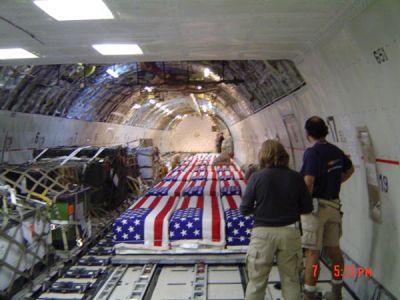
It is a quite similar inspiration that besets those with a camera in hand. So many photots are taken seeking just those few that are exactly right. Exactly poetry, and needing no further words. Tami Silicio did this and got fired.
Since 1991, photographing of the caskets of dead U.S. soldiers has been banned. It was a ban that was never enforced until now. Tami Silicio took a series of photos of this, and one got published in the Seattle Times. This is what she was fired for.
Tami Silicio did not have any political intent in her mind when she gave her photos over to the press. Instead, she was just awed by the great reverence with which we treat our fallen soldiers, and wanted the rest of us to know that we were indeed acting in that fashion. Nothing more. She saught to exault the dead; not exploit them. And she was fired for that.
Later that day, they also fired her husband for what she had done.
| Photo 1 | Photo 2 |
If a picture is worth a thousand words, Tami Silicio has made her point.
I'm very impressed with Carter here (as I often am) because while I am an Atheist and he is an evangelical, he's still hit the nail right on the head regarding the fundamentalists.
It is worth making clear from the outset that Patrick Henry College in rural Virginia is not your average American university. At Patrick Henry, the students - about 75 per cent of whom have been taught at home rather than in schools - are required to sign a statement of faith before they arrive, confirming (among other things) that they have a literal belief in the teachings of the Bible. At Patrick Henry, students must obey a curfew. They must wear their hair neatly and dress "modestly".Be afraid. Be very afraid.Students must also obey a rule stating that if they wish to hold hands with a member of the opposite sex, they must do so while walking: standing while holding hands is not permitted. And at Patrick Henry, students must sign an honour pledge that bans them from drinking alcohol unless under parental supervision.
Yet these things alone do not make the college special. ...
So, it was a holy war, a new crusade. No wonder George W. Bush could lie to Congress and the American public with such impunity while keeping the key members of his Cabinet in the dark. He was serving a higher power, according to Bob Woodward, who interviewed the president for a new book on the months leading up to the Iraq invasion.Of course, as a self-described "messenger" of God who was "praying for strength to do the Lord's will," Bush was not troubled about shredding a little secular document called the U.S. Constitution. ...
George W. Bush says he's been praying for fewer casualties in Iraq.How incredibly immense of the "bring it on" president. There's no substitute for resolute, concrete leadership, even if the praying comes between decisive bouts of hooking bass on the Crawford ranch back-40 while Americans and Iraqis are slaughtered in ever greater numbers.
No doubt Bush, on bended knee last year, also implored his lord to divinely hoodwink Americans with the weapons of mass destruction and Saddam's al-Qaida links catechism.
And lo and behold, God really is on Bush's side. ...
Why are we so focused on infecting others with our fears?
Why are we so intent on spreading them to our children?
What are we doing to ourselves?
The fourth of the five-part Woodward serailizationof "Plan of Attack" from the Washington Post:
| Part 1: Deciding on War |
Part 2: Making the Case |
Part 3: Cabinet Divided |

For years, we have been told most Americans are conservative -- and that is probably true. Nobody calling himself a "liberal" has been elected president in 40 years. The situation now is so desperate that anyone who loves this country and cares about the world has to do everything in their power to see that the conservative candidate wins the presidential election in November.That would be John F. Kerry, of course.
No, that's not a trick answer. ...
The American press needs to end its lovey-dovey relationship with the Pentagon. The Pentagon has provided ample evidence that it can propagandize the American people without the help of a lap-dog press.It is not the job of the press to support the troops. That is the duty of the American people, their loved ones and their folks back home. ...
The military and the press have two separate functions. The job of the military is to kill people and destroy assets. The job of the press is to report on the process. If the brass want to call killing civilians "collateral damage," so be it, but journalists should report that civilians have been killed. ...
The sought after has finally arrived. It's been well over a year, closer to two, since the formal Council of Conspirators began to plot the arrival of this day. Finally WAR has arrived in all its blood and ruin-all it's chaos and oblivion. ...
Of course, I had to straighten him out:
Dear Mr. Murphy,A few brief points to clear up before I address your vote (or lack thereof):
Regarding your deep dislike of John Kerry, I understand that. I don't much care for him myself. There is indeed little that Mr. Kerry offers to any serious liberal. Your suggestion that Mr. Kerry might perhaps be worse than Mr. Bush however clearly shows that you do not understand Mr. Bush.
- Skull & Bones is a college fraternity. They have skulls and bones and robes and death rituals and vows of silence and wild howling parties at 3 A.M. ... just like my fraternity did. Just like all fraternities do. Shall we then forever ban anyone who ever joined a fraternity from public office? This is a non-issue.
- Feeling a sense of patriotic duty common during the Vietnam days, John Kerry went to Vietnam where he quite likely did some very nasty things ... just like the more than one million other young men who served in Vietnam. Shall we then forever ban anyone who ever served in Vietnam from public office? This is a non-issue.
- Your desire to cut the Pentagon budget by 15% is admirable (though I would wish to cut far more). The trouble is that it just isn't going to happen, at least not anytime in the near future. If you wish to work towards this goal, you would do well to lay out perhaps a 20 year gameplan during which you plan to radically alter the American sentiment. If you are even successful, it will certainly take that long.
Presidents are not solo actors. They are merely the most prominent face in a large organization that they bring into office with them. In the case of John Kerry, one would feel fairly confident that he would also be the strong hand that steered his organization. In the case of Mr. Bush however, we already know that he does not exert this same type of strong hand leadership over his organization. This of course serves to elevate the powers of the individual actors within his organization, and this is where the problem with Mr. Bush comes in.
You have suggested that both Mr. Kerry and Mr. Bush share the same backers. To some extent this is true. Certainly they share the military-industrial complex and the globalizationists (together, the Corporatists). Mr. Bush however brings in two additional backers that Kerry does not: the Neocons and the Christian Fundamentalists. To suggest then that Kerry = Bush then is to ignore this second set of backers of Mr. Bush.
The Corporatists of course are about making money. While making money is certainly necessary, you likely are of a mind that they focus to completely on this, sacrificing as they do social concerns, and I would agree with you on this. But Corporatists do have one very necessary trait; they operate on facts. They might not emphasize the same facts that you or I would, but they do operate on facts. As such, they are rational (and reasonably predictable) actors. The same cannot however be said regarding the Neocons and the Christian Fundamentalists.
These last two groups come with pre-formed sets of ideologies that are not fact-based. In other words, they simply believe something regardless of whether or not real world experiences bear out those beliefs, and in fact will not change those beliefs when facts directly refute them.They are penultimate ideologues.
Now I do not intend to get into a detailed discussion of the beliefs of either of these groups (this could take books) but to say that their beliefs are very dangerous and their end goals share a common element: absolute power. Both of these groups, given the opportunity provided by a second Bush term, would institute extremely harsh penalties for any and all forms of dissent, and both would remove your right to vote. This is the difference between Mr. Kerry and Mr. Bush. With Mr. Kerry, you will actually get to vote again in 2008. With Mr. Bush, you will not. And that is a very big difference.
You are correct, Mr. Murphy. You are not going to get much of what you (and I) desire if you vote for Kerry and he is elected. But you are also not going to lose much, and you will have another chance at it in four years. It is indeed a pity that this is our choice in this election, but it is foolish to ignore the fact that it is.
With regards,
Benedict@Large
they are at the heart of power
To understand what is happening in the Middle East, you must first understand what is happening in Texas. To understand what is happening there, you should read the resolutions passed at the state's Republican party conventions last month. Take a look, for example, at the decisions made in Harris County, which covers much of Houston.Welcome to Texas, the "Rapture" state.The delegates began by nodding through a few uncontroversial matters: homosexuality is contrary to the truths ordained by God; "any mechanism to process, license, record, register or monitor the ownership of guns" should be repealed; income tax, inheritance tax, capital gains tax and corporation tax should be abolished; and immigrants should be deterred by electric fences. Thus fortified, they turned to the real issue: the affairs of a small state 7,000 miles away. It was then, according to a participant, that the "screaming and near fist fights" began.
I don't know what the original motion said, but apparently it was "watered down significantly" as a result of the shouting match. The motion they adopted stated that Israel has an undivided claim to Jerusalem and the West Bank, that Arab states should be "pressured" to absorb refugees from Palestine, and that Israel should do whatever it wishes in seeking to eliminate terrorism. Good to see that the extremists didn't prevail then.
But why should all this be of such pressing interest to the people of a state which is seldom celebrated for its fascination with foreign affairs? The explanation is slowly becoming familiar to us, but we still have some difficulty in taking it seriously.
In the United States, several million people have succumbed to an extraordinary delusion ...
What makes the story so appealing to Christian fundamentalists is that before the big battle begins, all "true believers" (ie those who believe what they believe) will be lifted out of their clothes and wafted up to heaven during an event called the Rapture. Not only do the worthy get to sit at the right hand of God, but they will be able to watch, from the best seats, their political and religious opponents being devoured by boils, sores, locusts and frogs, during the seven years of Tribulation which follow.Go read.The true believers are now seeking to bring all this about ...
"We can laugh at these people, but we should not dismiss them."
Old joke: A man repeatedly rides a bike across the Mexican-U.S. border. Each time, he's stopped by Customs and the bike is taken apart. Nothing is found. Finally, one day a Customs official offers the man immunity from prosecution if only he will tell what he's smuggling. The man pauses for a second, shrugs and says, "Bicycles."Cohen's conclusion? Bush's very real conviction that "he is a servant of God and history, chosen to liberate Iraq." He's probably correct in this too, as the evidence points to this strongly.* * *The "bicycle" in this case has been in plain sight ...
The problem with Cohen's conclusion is that it is incomplete. Certainly the likes of Dick Cheney and Paul Wolfowitz did not follow some messianic vision that Bush might possess simply out of loyal to their "commander in chief". They had to have their own reasons quite apart from this Bush "vision". Indeed, as Wolfowitz himself boldly (though perhaps stupidly) admitted in his Vanity Fair interview:
In other words, "weapons of mass destruction" was a compromise, and not likely anyone's first reason for signing on to the war against Iraq. Indeed, the 12 million protesters that turned out for the pre-war public demonstrations largely had this exact same sense: We know that this war is not about WMDs, so tell us what it is really about, and maybe we can talk about it. The Bush administration could not of course do this, because even they could not agree."... for bureaucratic reasons, we settled on one issue - weapons of mass
destruction, because it was the one reason everyone could agree on."
Still, Cohen's conclusion is instructive because it does offer an answer to a second question I've had: Since the reasons for supporting the war were so very divided and since all supporters of the war would need to be represented in the war cabinet in order to garner the necessary public support for the war, who there was representing the Christian Fundamentalists? Obviously, Bush himself.
| Part 1: Deciding on War | Part 2: Making the Case |

But it gets even worse when Woodward comes to the quid pro quo of this:
Prince Bandar enjoys easy access to the Oval Office. His family and the Bush family are close. And Woodward told 60 Minutes that Bandar has promised the president that Saudi Arabia will lower oil prices in the months before the election - to ensure the U.S. economy is strong on election day.Now I don't know if any laws are being broken here, but I'm certainly not too interested in a Saudi prince manipulating our elections. More amazingly however, if Woodward's account is correct, members of the administration have just looked at a Saudi prince and said, "Sure. Go ahead. Manipulate the U.S. economy. That's fine with us."Woodward says that Bandar understood that economic conditions were key before a presidential election: "They're [oil prices] high. And they could go down very quickly. That's the Saudi pledge. Certainly over the summer, or as we get closer to the election, they could increase production several million barrels a day and the price would drop significantly."
He's with the National Security Council, in the situation room. Says Woodward: "They have all these TV monitors. Gen. Franks, the commander, is up on one of them. And all nine commanders, and the president asks each one of them, 'Are you ready? Do you have what you need? Are you satisfied?' And they all say, 'Yes, sir.' and 'We're ready.'"Tears? And a salute? Scarey. But wait:Then the president saluted and he rose suddenly from his chair. "People who were there said there were tears in his eyes, not coming down his cheeks but in his eyes," says Woodward. "And just kind of marched out of the room."
Having given the order, the president walked alone around the circle behind the White House. Months later, he told Woodward: "As I walked around the circle, I prayed that our troops be safe, be protected by the Almighty. Going into this period, I was praying for strength to do the Lord's will. I'm surely not going to justify war based upon God. Understand that. Nevertheless, in my case, I pray that I be as good a messenger of his will as possible. And then, of course, I pray for forgiveness."Excuse me? Bush "not going to justify war based upon God," but then launches into "a higher Father that I appeal to"? What does that mean? That he's not going to tell us that this is what he's done?Did Mr. Bush ask his father for any advice? "I asked the president about this. And President Bush said, 'Well, no,' and then he got defensive about it," says Woodward. "Then he said something that really struck me. He said of his father, 'He is the wrong father to appeal to for advice. The wrong father to go to, to appeal to in terms of strength.' And then he said, 'There's a higher Father that I appeal to.'"
Want more? You're in luck. From Sunday through Thursday, Woodward will be publishing a five article adapted from "Plan of Attack" in the Washington Post. The first two are linked below, with each being five pages.
Two additional articles on Colin Powell, because he stands to be the big loser here. From the New York Times:
Dowd offers an armchair analysis of the personalities.
Tests Ties in the Cabinet
A couple of notes on the article:
- "As a State Department and Pentagon official and at the Rand Corporation, he advocated pre-emptive action against so-called rogue states like Iraq." - This is somewhat of an understatement. Khalilzad was a member of the PNAC.
- Khalilzad "briefly defended the Taliban while working as a consultant for Unocal, the oil company that was then trying to build a pipeline through Afghanistan. He later became one of the Taliban's fiercest critics." - This is somewhat misleading on two points. First, Unocal wasn't trying to build a pipeline at this time. They were trying to negotiate a contract with the Taliban to build one, and Khalilzad was acting as a broker for Unocal in this effort. Obviously he defended the Taliban during these nogotiations and turned on them when the Unocal negotiation broke down.
Second, not mentioned here is that UNOCAL did sign a pipeline contract with the new Afghanistan government, and is currently in a pre-construction phase of that project.
 Chris Floyd:
... pledging their fealty to Jesus Christ and His teachings of mercy and lovingkindness -- while ordering missile strikes on crowded cities, while filling hospitals with the mutilated bodies of young children, while shoveling fat war profits to their cronies and contributors. Only the most craven, bootlicking sycophant could fail to be revolted at the hypocrisy of these murderous cynics. They're a perfect match in moral idiocy for their crack-brained brother-in-arms, Osama bin Laden.It wouldn't have mattered if Saddam had found Jesus, or freed his people, or set himself on fire in Madison Square Garden: The Bushists were always going to invade and occupy Iraq -- always, no matter what.* * *... the conquest of Iraq has nothing to do with terrorism or liberation or WMD or national security or Arab democracy or Bush family revenge. It has been planned for years by Cheney, Wolfowitz, Rumsfeld and other Bush retainers, planned openly, and for one reason only: to give the United States direct military control of the Middle East in order to dominate global economic and political life for "the New American Century." This need was so great, said the group -- openly, in September 2000 -- that it "transcends the issue of the regime of Saddam Hussein."
I actually had a ducky time last night myself during the Chimp's "duh"-op. From an e-mail to a friend:Now if Bush would just quit speaking in public and giving me
more free material for my movie, I can get back to work ...
Did I see the "news conference"? You should have been here for it! A few folks were over, and I told them all to shut up as I listened. Well, they did, but I did not. Before he could finish a sentence, I was yelling and waving my hands calling him a liar and explaining why to my guests. By half way through, they were laughing at me, not in a bad way, but rather because they couldn't wait for Bush to start speaking again so that I could kick sand in his face! I was "going Malloy" on them, and they were loving it.Maybe I'm clarvoiant?I think what started all the fun was when my head rolled back so far it almost fell off. Bush hadn't yet mentioned 9-11 when I yelled, "You son of a bitch! You're going to say 9-11!" Sure enough, about 20 seconds later, he did. But here's the thing: Every single time he did, I announced to my guests at least ten seconds before he did that he was about to do so. And I was never wrong! No wonder Mike Malloy has high blood pressure.
BASRA, April 12 (MNA) -- Fifty days after the first reports that the U.S. forces were unloading weapons of mass destruction (WMD) in southern Iraq, new reports about the movement of these weapons have been disclosed.Original story below.Sources in Iraq speculate that occupation forces are using the recent unrest in Iraq to divert attention from their surreptitious shipments of WMD into the country.
An Iraqi source close to the Basra Governor's Office told the MNA that new information shows that a large part of the WMD, which was secretly brought to southern and western Iraq over the past month, are in containers falsely labeled as containers of the Maeresk shipping company and some consignments bearing the labels of organizations such as the Red Cross or the USAID in order to disguise them as relief shipments.
The source, who spoke on condition of anonymity, added that Iraqi officials including forces loyal to the Iraqi Governing Council stationed in southern Iraq have been forbidden from inspecting or supervising the transportation of these consignments. He went on to say that the occupation forces have ordered Iraqi officials to forward any questions on the issue to the coalition forces. Even the officials of the international relief organizations have informed the Iraqi officials that they would only accept responsibility for relief shipments which have been registered and managed by their organizations.
The Iraqi source also confirmed the report about suspicious trucks with fake Saudi and Jordanian license plates entering Iraq at night last week, stressing that the Saudi and Jordanian border guards did not attempt to inspect the trucks but simply delivered them to the U.S. and British forces stationed on Iraq's borders.
However, the source expressed ignorance whether the governments of Saudi Arabia and Jordan were aware of such movements.
A professor of physics at Baghdad University also told the MNA correspondent that a group of his colleagues who are highly specialized in military, chemical and biological fields have been either bribed or threatened during the last weeks to provide written information on what they know about various programs and research centers and the possible storage of WMD equipment.
The professor also said these people have been openly asked to confirm or deny the existence of research or related WMD equipment. A large number of these scientists, who are believed to be under the surveillance of U.S. intelligence operatives, have claimed that if they refuse to comply with this request, they may be killed or arrested on charges of concealing the truth if these weapons are found by the Bush administration in the future.
He said that the Iraqi scientists believe their lives would be in danger if they decline to cooperate with the occupation forces, especially when they recall that senior U.S. officer Michael Peterson once said, "Iraqi scientists are at any case a threat to the U.S. administration, whether they talk or not."
A source close to the Iraqi Governing Council said, "In the meantime, many suspect containers disguised as fuel supplies have been moved about by some units of the U.S. special forces. The move has been carried out under heavy security measures. Also, there are unofficial reports that the containers held biological and bacteriological toxins in liquid form. It is possible that the news about the discovery of the WMDs would be announced later."He also said that such mixtures had been used by the Saddam regime in the 1990s.
The source added that some provocative actions such as the closure of Al-Hawza periodical by U.S. administrator Paul Bremer, the secret meetings between his envoys with some extremist groups who have no relations with the Iraqi Governing Council, the sudden upsurge in violence in central and southern Iraq, a number of activities which have stoked up the wrath of the prominent Shia clerics, and finally, the spate of kidnappings and the baseless charges against the Iranian charge d'affaires in Baghdad are providing the necessary smokescreen for the transportation of the WMD to their intended locations.
He said they are quite aware that the White House in cooperation with the Central Intelligence Agency (CIA) has directly tasked the Defense Department to hide these weapons. Given the recent scandals to the effect that the U.S. president was privy to the 9/11 plot, they might try to immediately announce the discovery of weapons of mass destruction in Iraq in order to overshadow the scandals and prevent a further decline of Bush?s public opinion rating as the election approaches.
On March 13 the Iranian news agency Mehr reported a story that, if true, is surely the biggest news of this election year: "U.S. forces have unloaded a large cargo of parts for constructing long-range missiles and weapons of mass destruction (WMD) in the southern ports of Iraq.* * *Five days after Mehr broke this story, a Google and Lexis/Nexis search failed to find it reported in any U.S. news source. Not even a story to say "We checked and found nothing to support the allegations." Why? Two possibilities come to mind. Perhaps American journalists in Iraq, and their editors at home, saw it and said "Oh, that's silly. With all the serious stuff we have to investigate, why waste a good reporter's precious time on such nonsense?"* * *The other possibility is that some American journalists believe the U.S. might indeed be planting WMD parts in Iraq for pre-election "discovery." But the story is just too hot, too dangerous to touch.
Published in its entirety:
TEHRAN (Mehr News Agency) -- Over the past few days, in the wake of the bombings in Karbala and the ideological disputes that delayed the signing of Iraq's interim constitution, there have been reports that U.S. forces have unloaded a large cargo of parts for constructing long-range missiles and weapons of mass destruction (WMD) in the southern ports of Iraq.A reliable source from the Iraqi Governing Council, speaking on condition of anonymity, told the Mehr News Agency that U.S. forces, with the help of British forces stationed in southern Iraq, had made extensive efforts to conceal their actions.
He added that the cargo was unloaded during the night as attention was still focused on the aftermath of the deadly bombings in Karbala and the signing of Iraq's interim constitution.
The source said that in order to avoid suspicion, ordinary cargo ships were used to download the cargo, which consisted of weapons produced in the 1980s and 1990s.
He mentioned the fact that the United States had facilitated Iraq's WMD program during the 1980-1988 Iran-Iraq and said that some of the weapons being downloaded are similar to those weapons, although international inspectors had announced Saddam Hussein's Baath regime had destroyed all its WMD.
The source went on to say that the rest of the weapons were probably transferred in vans to an unknown location somewhere in the vicinity of Basra overnight.
"Most of these weapons are of Eastern European origin and some parts are from the former Soviet Union and the Eastern Bloc. The U.S. obtained them through confiscations during sales of banned arms over the past two decades," he said.
This action comes as certain U.S. and Western officials have been pointing out the fact that no weapons of mass destruction have been discovered in Iraq and the issue of Saddam's trial begins to take center stage.
In addition, former chief UN weapons inspector Hans Blix has emphasized that the U.S. and British intelligence agencies issued false reports on Iraq leading to the U.S. attack.
Meanwhile, the suspicious death of weapons inspector David Kelly is also an unresolved issue in Britain.
Occupation Forces Official Claims to Have No
Information About Transfer of WMD to IraqA security official for the coalition forces in Iraq said that he has not received any information about the unloading of weapons of mass destruction in ports in southern Iraq.
Shane Wolf told the Mehr News Agency that the occupation forces have received no reports on such events, but said he hoped that the coalition forces would find the Iraqi weapons of mass destruction one day.
Coalition forces and inspectors have so far been unable to find any Iraqi weapons of mass destruction. The U.S. invaded Iraq under the pretext that Iraq possessed a stockpile of weapons of mass destruction.

Be sure to also head on over to The White Rose Society, where Mike Malloy's professional "Demo" CD has just been posted (about half-way down) for your downloading pleasure. White Rose also has the "Heretic Cut" Malloy CD posted, as well as archives of Malloy Shows back to 12/15/2003. Toss a few bucks at White Rose webmaster Ben Burch if you can while you're there. Your contributions are the only way Ben keeps White Rose alive.
And you thought you knew everything.
I might add one additional detail however. Since he spent so much time away from the office, shouldn't we pro-rate that back against how much time he actually spent there doing his job?
The Bush administration, I fear, is severely learning-disabled.I'm telling you, there's trouble brewing with Georgie's home boys!Rational people, acting as individuals or as a group, learn from their mistakes. They gather data, they make decisions, and they take actions. Then they assess the feedback from reality and adjust.
* * *Well, I hope you share the president's faith. The same people who failed to protect us in September 2001 are still where they were. So is Paul Wolfowitz, the architect of the Iraq War, who said we would be greeted with flowers and dancing in the streets. Bush ought to put him in charge of Iraq. He deserves to live in Baghdad for the rest of his life.
And Charley? I'm with you on Wolfie as Ambassodor to Iraq! They greeted him so warmly last time he visited.
As I write this, civil war is about to erupt in Iraq -- a pending conflict stemming from a Bush-waged war based on a family vendetta and oil-based greed. In the meantime, a disproportionately funded force in Afghanistan is making little to no headway in its search for the true villain of the modern world.* * *Nixon must be rolling in his grave -- and offering Bush a nod of approval.
couldn't get anything done for the first 233 days?
Top 15 Reasons
why you should vote for him for president
instead of George Bush.


"They stole our playground," an eight-year-old boy in Sadr City told me this week, pointing at six tanks parked in a soccer field, next to a rusty jungle gym. The field is a precious bit of green in an area of Baghdad that is otherwise a swamp of raw sewage and uncollected rubbish.Sadr City, the next Fallujah.Sadr City has seen little of Iraq's multibillion-dollar "reconstruction", which is partly why Moqtada al-Sadr and his Mahdi army have so much support here. Before the US occupation chief, Paul Bremer, provoked Sadr into an armed conflict by shutting down his newspaper and arresting and killing his deputies, the Mahdi army was not fighting coalition forces, it was doing their job for them.
After all, in the year it has controlled Baghdad, the Coalition Provisional Authority still hasn't managed to get the traffic lights working or to provide the most basic security for civilians. So in Sadr City, Sadr's so-called "outlaw militia" can be seen engaged in such subversive activities as directing traffic and guarding factories from looters. In a way, the Mahdi army is as much Bremer's creation as it Sadr's: it was Bremer who created Iraq's security vacuum - Sadr simply filled it.
Nothing could have been easier than gaining the good-will of the people of Fallujah had the Americans not been so brutal in their dealings. Tribal peoples like these have been the most easily duped by imperialists for centuries now. But now a tipping point has been reached. To Americans, “Fallujah” may still mean four mercenaries killed, with their corpses then mutilated and abused; to Iraqis, “Fallujah” means the savage collective punishment for that attack, in which over 600 Iraqis have been killed, with an estimated 200 women and over 100 children (women do not fight among the muj, so all of these are noncombatants, as are many of the men killed).Vietnam redux.A Special Forces colonel in the Vietnam War said of the town, Ben Tre, “We had to destroy the town in order to save it.” That statement encapsulated the Vietnam War. The same is true in Iraq today -- Fallujah cannot be “saved” from its mujaheddin unless it is destroyed.
1
What have we gained or will we gain from this war in Iraq other than more dead Americans?Is our oil cheaper? No, it's more expensive.
Are the Iraqi people free? No, and they obviously do not wish to be free.
Has the threat of terrorism at home decreased? No, it has increased as we make more enemies every day while fighting an excursion in Iraq rather than focusing our total efforts and energies on real terrorists.
The commander in chief needs to take care of his troops before it's too late. ...
The key of course is that the Iraqis themselves must draw the lines of the split. Of course, we (and hopefully the U.N.) would moderate that negotiation, but the final determination would be the Iraqis'. Once that determination was made, U.S. (hopefully a by this time internationalized) troops would then withdraw, being at this time responsible only for border enforcement, a role that would be played until the new states could develop their own governments and security forces. Now there are three problems that would have to be solved to make this work.
First, the eventual division would quite likely leave most developed oil production in the Shia and Kurdish states. The Sunnis would have oil, but it would take them a while to bring it on-line. We would likely need to provide the Sunnis with some sort of economic assistance while this occurred, perhaps in the form of manufacturing development aid.
Second, wherever these lines are drawn, there are large areas where the sects live intermingled, and this could present a large refugee problem if left unadressed. To solve this, we would need to provide a second level of economic assistance, this time to individual citizens wishing to relocate across the new borders. This might also include some job creation assistance to insure a smooth resettlement.
Finally, Turkey, who is quite opposed to the creation of a Kurdish state. The relocation asssistance might also be extended to Turkish Kurds, and a separate negotiation between the Kurdish state and Turkey (again, moderated by us) to insure that both parties had reasonable assurances that there would be no cross-border interference.
All of this of course would hinge on the prompt removal of the feeding trough for U.S. multi-nationals. This is something that the Bush administration simply cannot do, and it is probably the primary reason why so little progess has been made during the last year.
On the bright side, this will give me some time for some off-line projects as well as time to get my second computer back together. Who knows, ... maybe I'll even be able to get my "voodoo" home network (a cross-over cable) working at long last. It never wanted to work quite right last time, and if you've ever had a home networking problem before, you know how very little help the manufacturers provide.
In the meantime, have a good holiday!


Collected observations on Rice's appearance from various talk-radio programs:
- From a former ad-man: It was clear early on that Condi's strategy (no doubt via coaching) was to bore people into not watching.
- From a Washington lawyer: Beyond offering opinions, Condi didn't say much, and contradicted even those opinions as she spoke. Clinton did a bad job./We did as good as Clinton. (I love these.) We were very active on this./You can't really expect us to get much done in 227 days.
- From a progressive author: With "friendly" questioners, Condi's answer were short, allowing more "softballs" to be tossed at her. With "unfriendly" questioners, Condi "fillibustered" her answers, running those questioners out of time.